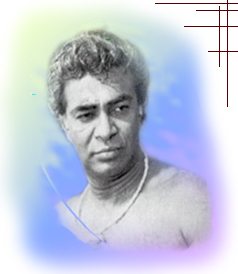
But with Chitrasena, forty years of dancing is
something positively and intensely more
significant, more important. Undoubtedly for him too, the completion of this long period
carries a sense of personal achievement, bringing memories of struggle and triumph of
quest and conquest of bitter and happy days, of lean and prosperous years.
But these achievements and trimphs are now no more individual and personal. Here, at the
end of these forty years, Chitrasena emerges in our retrospective vision, an important
artist in an important epoch - whose forty years are now become an indelible part of a
country's cultural history; whose personal achievements are now, inseparable elements in a
nation's aesthetic and emotional life. His trimphs have so much composed our present, that
his failures too must now be reckoned as inalienable from our national destiny. If ever we
as a nation, have the capacity to evaluate our own artists, we have now come to a
stage,... or rather, Chitrasena has brought us to a stage, when we shall have to speak of
his successes and defeats as ours.
Important epoch
It was indeed in the middle of an important epoch that Chitrasena emerged, as yet another
maker of that age in which we live. The Anagarika Dharmapala had fulfilled his spiritual
mission and the first fruits of his life's - work were only being harvested. Ananda
Coomaraswamy was rediscovering the indigenous arts and had already addressed his
celebrated Letter to the Kandyan Chiefs. In India, Tagore had established his
Shantiniketan. His lectures on his visit to Sri Lanka, in 1934 had inspired a
revolutionary change in the outlook of many an educated man and woman. The Poet-Sage of
re-awakened India had stressed the need for a people to discover its own culture to be
able to assimilate fruitfully the best of other cultures.
Chitrasena was a school-boy then, and the house of his father, Seebert Dias, a well-known
actor of the day had become a veritable cultural centre, in and out of which went the
literary and artistic intelligentsia of the time, Seebert Dias, whose acting as Shylock
had captivated the English-speaking audiences, now produced the first Sinhala ballet,
Sirisangabo 'presented in Kandyan technique'. Chitrasena played the lead role, and people
were talking of the boy's talents.
Some years before, Pavlova had visited India and taken away Udaya Shankar to Europe where
his performances were making a name for all Oriental dancing. Menaka and her Kathak
performances and Ram Gopal's Bharata Natyam were acquiring international fame. Some of
these famous Indian exponents of the dance had already visited Sri Lanka.
In Sri Lanka's upper layers the parlour-piano and musical Victoriana were being abandoned
in favour of Kandyan dancing, the sitar and the esraj. A new elite was rising which was
turning a self-conscious if sentimental eye towards the indigenous arts. While there was a
fair amount of romanticism and ostentation in all this, the trend was not altogether
without authenticity and conviction, and it was as the movement was gathering momentum
that a right intuition sent Chandralekha, the wife of the artist JDA, and Chitrasena to
study Indian dancing under the traditional Indian gurus.
Their first choice was the Chitrodaya School of Travancore where they were to study
Kathakali, the dance drama of Kerala, under the celebrated guru Gopinath who later, at the
completion of Chitrasena's training said of him in that typical prophetic style of the
Oriental gurus "He will soon become a great dancer, having no rival in the art".
Despite this trend the major tide of colonial civilization flowed unabated. A
slavishly-imitative elite, half-baked in European manners and victims of the West's
post-industrial commercial culture, still ruled the roost and set the pace, inciting among
the nationalist elite a cultural chauvinism equally virulent.
Desperate struggle
Meanwhile in the villages the traditional masters of the dance held tenaciously to their
art in a desperate struggle to preserve it for posterity. But with democratic institutions
had come social mobility. Their sons, lured by the glitter and gold of the cities were
exercising their new-found freedom and abandoning the hereditary art for the more secure
jobs of peons and porters.
They were being realistic. They were right. The Sinhala dance was fighting a losing battle
in the villages, among the commonfolk. The old social structures which sustained it had
given way. The aristocracy had now shifted their interests to the Bridge table of the
Planters' Club. Before the advance of modern medicine, the exorcist ritual was dying a
natural death. Thus the less-enterprising of the dancer's sons inherited his father's
profession only to ensure for the art a mediocre existence. Purity of the dance was
secured only through stagnation masquerading as Tradition. Incompetence and dilettantism
ensured their own survival by vulgarization whose nadir was reached a few decades ago in
the Kandyan Cha-Cha. There was no doubt, patriotism and a pittance could not rescue the
Sinhala dance from a sure and gradual death.
It was in this context that Chitrasena returned with his training from India. Like any
other contemporary artist of Sri Lanka, Chitrasena stood where the road he travelled on
seemed to fork out in two directions - the Path of Traditionalism stood counterposed with
that of Innovation, Conformity with Rebellion, Nationalism with Internationalism,
University with Particularity. In his own field, Chitrasena stood where Martin
Wickramasingha stood in the Novel, Keyt in Painting, Sarachchandra in Drama, Lester James
Pereis in the film, Amaradeva in music. Chitrasena too accepted the Challenge. The art
must grow if it was to be saved from extinction. Thus Chitrasena brought dynamism to the
tradition of the dance in Sri Lanka. And he had the deftness of touch and the awareness of
the problems to conduct that delicate surgery which could, effect a synthesis of tradition
and modernity without sacrilegious results to the art.
Excerpts from the book Nurtya Puja which was published to celebrate Chitrasena's 50 years
of dance
by Bandula Jayawardhana |